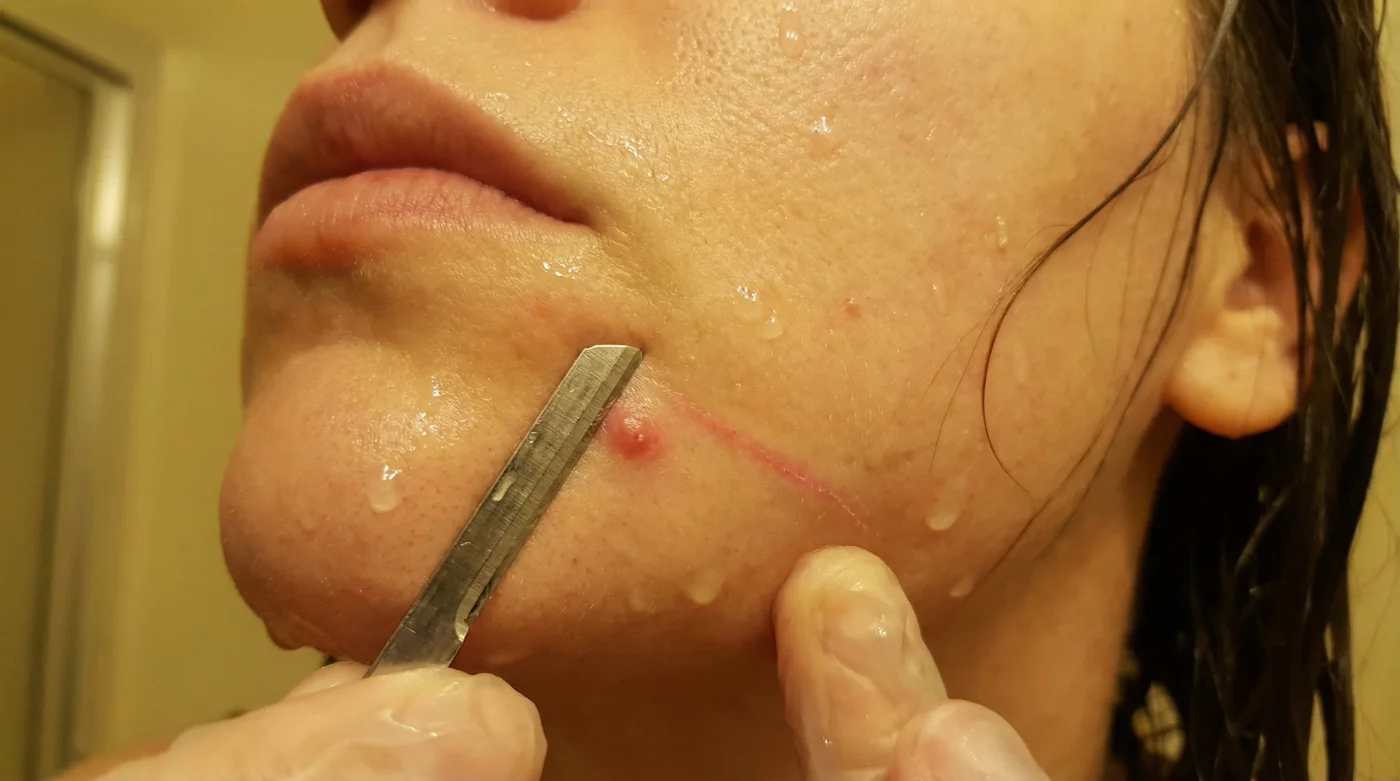
You stand under the warm, slightly buzzing light of your bathroom mirror. Condensation drips down the glass, a lingering ghost of your evening shower. You reach for that brightly coloured, at-home dermaplaning wand, splash a little warm water across your cheeks, and begin to scrape. It feels intuitive, doesn’t it?
We are taught from a young age that water equals safety. That moisture brings a gentle slip. But as the blade drags across your damp jawline, you are not just removing peach fuzz. You are actively tearing the softened architecture of your skin and pressing naturally occurring staphylococcal bacteria directly into the fresh wounds.
The Fiction of the Wet Shave
The assumption that wet shaving is always safer is a stubborn myth. It is easy to confuse the thick, protective lather required for a multi-blade razor on thick beard hair with the precision required for a single-edge exfoliating blade. When you dermaplane, your goal is to gently lift away dead keratin and fine vellus hair. But when your face is wet, the skin acts like a sponge.
The cells swell with water, turning a crisp layer of dead skin into a sticky, rubbery paste. Think of it like aquaplaning on a flooded motorway. Instead of the blade gripping the road and sweeping away the debris, it loses traction. It skips, stutters, and catches.
These invisible stutters create micro-tears. Staph bacteria, which live harmlessly on the surface of almost everyone’s skin, suddenly find themselves pushed into these warm, damp, microscopic fissures. Within twenty-four hours, what you thought was a simple breakout is actually a mild, localised bacterial infection.
I learned this over a cup of Earl Grey with a senior aesthetician tucked away in a quiet clinic just off Marylebone High Street. She shook her head at the mention of shower-shaving. “People treat dermaplaning like trimming the hedges,” she said. “It is actually surface restoration.”
“When the skin is damp, the blade rips rather than cuts. You need a completely dry surface, cushioned only by oil, to give the blade a predictable path.”
| Target Audience | Specific Benefits of Oil-Prepped Dry Dermaplaning |
|---|---|
| Sensitive or Redness-Prone Skin | Prevents blade-skipping friction that triggers histamine responses. |
| Acne-Prone Skin (Clear phases) | Stops water-borne bacterial transfer into freshly exfoliated pores. |
| Mature or Thinning Skin | Maintains structural integrity without tearing water-swollen cells. |
The Biological Mechanics of the Blade
To understand why oil triumphs over water, we have to look at how friction interacts with human biology. Water evaporates rapidly, changing the friction coefficient second by second as you work across your face. Oil remains stable. It creates a micro-barrier that allows the sharp edge to cleanly slice hair at the base while gliding over the skin’s healthy layers.
This method, often referred to as ‘oilplaning’ by professionals, is the only way to mimic a clinical treatment in your own bathroom.
| Environmental Condition | Blade Interaction | Bacterial Risk Factor |
|---|---|---|
| Damp/Wet Skin | High skipping rate; tearing of swollen corneocytes. | High (Staph introduced to micro-abrasions). |
| Completely Dry Skin | Moderate skipping; can feel scratchy on sensitive profiles. | Medium (Requires perfect blade angle to avoid irritation). |
| Dry Skin + Squalane Oil | Smooth glide; clean slicing of vellus hair. | Low (Oil barrier protects against surface tearing). |
The Ritual of the Oil-Prep
Transforming this hazardous habit into a safe, effective routine requires a shift in timing. Never dermaplane immediately after a hot shower. Your skin is too warm and too pliable. Instead, cleanse your face thoroughly, pat it dry with a clean towel, and wait at least ten minutes.
- Copper peptides applied alongside glycolic acid immediately destroy expensive active ingredients
- Liquid foundation blended with soaking wet sponges creates visible texture patches
- Unwashed silk pillowcases trap overnight hair oils triggering severe forehead breakouts
- At-home dermaplaning tools used on damp skin actively spread staph bacteria
- Undiluted apple cider vinegar scalp treatments permanently weaken hair follicle structures
You are not trying to baste a roast; you are just laying down a microscopic track for the tool. Pull the skin taut with two fingers—this is non-negotiable. If the skin moves, the blade catches. Hold the dermaplaning tool at a forty-five-degree angle and use short, feather-light strokes downward.
You should hardly feel the blade itself; instead, you will just hear a satisfying, quiet scraping sound. Wipe the blade on a clean cotton pad after every two strokes. When you finish, do not immediately apply harsh active ingredients like retinoids or vitamin C. A simple, soothing moisturiser is all your newly exposed skin needs to recover.
| Quality Checklist | What to Look For | What to Avoid |
|---|---|---|
| The Tool | Surgical steel blades, sturdy handle, protective micro-guards. | Flimsy plastic handles, rusted edges, blades used more than three times. |
| The Prep Medium | 100% Squalane, Jojoba, or Rosehip oil. | Water, thick shaving foams, heavy coconut oils, or heavily fragranced serums. |
| The Aftercare | Ceramide-rich moisturisers, gentle hyaluronic acid, SPF 50. | Glycolic acid, physical scrubs, immediate sun exposure. |
Reclaiming the Rhythm
Changing how we use a simple bathroom tool might seem minor, but it is a masterclass in respecting your body’s boundaries. By moving away from the rushed, damp scrape and embracing a measured, oil-prepped glide, you stop fighting your skin’s natural architecture. You cease the spread of hidden bacteria and, instead, foster a calm, predictable environment. It turns a chore into a moment of genuine care.
Your skin works tirelessly to protect you from the world. It builds walls, secretes oils, and manages an incredibly delicate microbiome. When we approach it with a sharp blade, we owe it the courtesy of proper preparation. Taking those extra ten minutes to dry and oil the face is not just about avoiding a breakout.
It is about acknowledging that good things, whether a perfectly smooth complexion or a quiet evening routine, require the right foundation.
“When we respect the skin’s barrier by preparing it with a bio-compatible oil, we turn an abrasive trauma into a therapeutic exfoliation.”
Frequently Asked Questions
Is it normal for the skin to feel slightly tight after dermaplaning?
Yes, a mild tightness is normal as you have removed the top layer of dead skin. However, stinging or burning indicates you have pressed too hard or the skin was damp and tore.Can I use baby oil to prep my face?
It is best avoided. Baby oil is largely mineral oil with added fragrance, which can clog freshly exfoliated pores. Stick to pure squalane or jojoba.How often should I be changing my dermaplaning blade?
At a maximum, after three uses. A blunt blade requires more pressure, which dramatically increases the risk of slipping and infection.What is the best way to clean the blade between uses?
Wipe it thoroughly with a cotton pad soaked in rubbing alcohol (surgical spirit) and allow it to air dry completely before storing it in a dry place.Can I dermaplane if I have an active breakout?
Absolutely not. Gliding a blade over active spots will shear the top off the blemish, spreading the infection across the rest of your face.