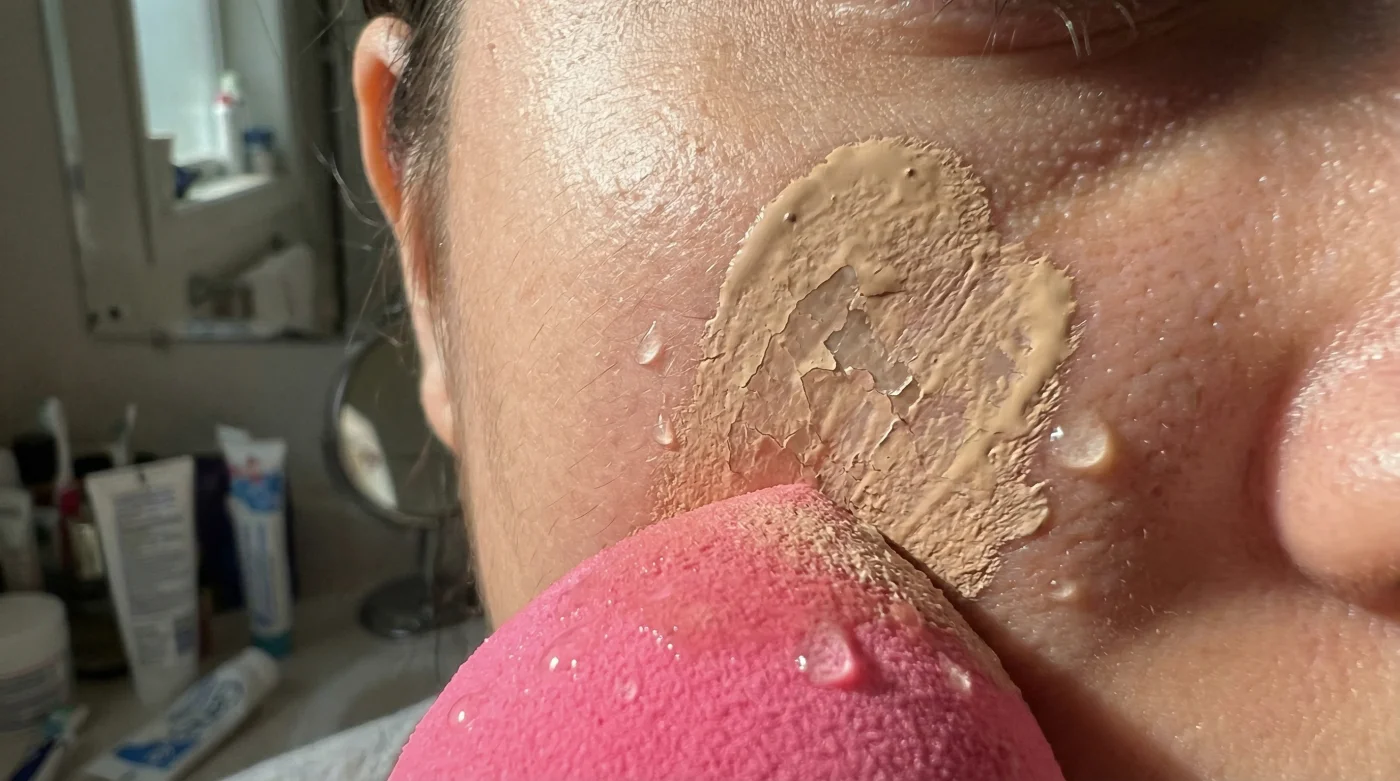
You are standing in the bathroom at seven in the morning. The cold tap is running. You hold your egg-shaped makeup sponge under the stream, watching it swell like a pink balloon. You give it a quick squeeze, hear that familiar wet squelch, and begin bouncing it across your cheek. But instead of a flawless glaze, you are left looking at tiny, separated puddles of beige. The foundation clings to dry patches you did not even know existed, sliding straight off the oilier zones of your nose and forehead. You blame the foundation. You blame your skin. You scrub it off and start again.
The Water-Logged Canvas
Mainstream beauty tutorials have sold you a frustrating myth. For years, glowing influencers have told you to saturate the sponge until it feels heavy, supposedly to hydrate the base and create a dewy finish. But think of a kitchen sponge wiping up a frying pan. Water and oil notoriously refuse to mix. Your liquid foundation, usually formulated with silicones, waxes, or oils, essentially breathes through a pillow of water when struck with a soaking-wet sponge.
The excess water thins the pigment unpredictably. It lifts the product instead of pressing it into your skin, creating a slippery barrier that guarantees visible texture patches by lunchtime.
I learned this the hard way backstage at a West End theatre, watching the lead makeup artist, Clara, prep a cast. While I was dutifully holding a sponge under a running tap for my own face, she intercepted me with a clean, dry cotton flannel. “Squeeze it in this,” she instructed, her hands deftly wrapping the fabric around the sponge and wringing it with surprising force. “You want the sponge to feel cold, not wet. If you can squeeze even a single drop of water from it, you are just going to wash the makeup straight off your face.”
| Skin Profile | Benefit of the Towel-Wrung Method |
|---|---|
| Oily & Combination | Prevents foundation from slipping off the T-zone by midday. |
| Dry & Flaky | Stops evaporating water from pulling natural moisture with it. |
| Mature | Keeps pigment concentrated so it does not settle into fine lines. |
| Acne-Prone | Allows for precise, stippled coverage without erasing concealer. |
The Art of the Towel-Wring
The solution requires a minor but deliberate change to your morning rhythm. Run your sponge under lukewarm water until it expands completely. Squeeze out the obvious excess over the basin.
Now, reach for a clean, dry towel or a thick cotton flannel. Wrap the sponge entirely in the fabric. Grip it firmly in your fist and squeeze as hard as you can.
When you unwrap it, the sponge should feel almost dry to the touch, but retain a cool, bouncy density. This is the sweet spot. It is now hydrated enough that it will not drink up your expensive foundation, but dry enough that it will not dilute the chemical structure of the formula.
- Copper peptides applied alongside glycolic acid immediately destroy expensive active ingredients
- Liquid foundation blended with soaking wet sponges creates visible texture patches
- Unwashed silk pillowcases trap overnight hair oils triggering severe forehead breakouts
- At-home dermaplaning tools used on damp skin actively spread staph bacteria
- Undiluted apple cider vinegar scalp treatments permanently weaken hair follicle structures
| Formula Component | Reaction to a Soaking Wet Sponge | Reaction to a Towel-Wrung Sponge |
|---|---|---|
| Silicone Base | Repels the water entirely, creating visible separation. | Melts evenly, allowing silicones to blur skin texture. |
| Water-Based | Over-dilutes the pigments, destroying intended coverage. | Maintains intended opacity and sets properly on the skin. |
| Heavy Concealer | Lifts immediately, exposing the blemishes underneath. | Blends the edges softly whilst keeping the core coverage intact. |
Calibrating Your Tools
Not all sponges respond identically to this technique. It is crucial to understand the material you are holding. A proper cosmetic sponge relies on an open-cell structure, meaning it is designed to fill with a precise amount of moisture to swell, rather than acting like a solid block of rubber.
When you squeeze it into a towel, the open cells release the superficial water but retain the structural expansion. This is the mechanical logic behind the flawless application.
| What To Look For | What To Avoid |
|---|---|
| An open-cell structure that bounces back instantly after squeezing. | Dense, rubbery textures that feel heavy even when completely dry. |
| A tear-drop shape for accessing the delicate corners of the nose and eyes. | Flat, geometric wedges that hold too much product in their sharp corners. |
| A slightly porous surface that mimics natural human skin texture. | Completely smooth, shiny surfaces that smear rather than stipple. |
A Morning Rhythm Restored
Adjusting this tiny variable transforms a frustrating daily chore into a quiet moment of satisfaction. You are no longer fighting your tools or blaming your complexion for behaving like a hostile surface. It is about working in harmony with the chemistry of the products sitting on your dressing table.
By taking that extra three seconds to wring your sponge firmly into a towel, you are giving your foundation the respect it deserves, and your face the seamless, reliable finish you paid good money for.
“Your cosmetic sponge should be a delivery vehicle for your foundation, not a water cannon diluting your hard work.”
Frequently Asked Questions
Do I need to wash the towel after every single use? Not necessarily. Because the sponge is freshly rinsed and you are squeezing out clean water, the towel is just absorbing water. A dedicated flannel can be hung up to dry and washed with your regular weekly laundry.
Can I use a paper towel instead of a cotton flannel? Yes, paper towels work in a pinch, but they generate unnecessary waste. A proper thick towel or flannel extracts more moisture due to its heavier weave.
Will this method work for applying liquid blush and bronzer? Absolutely. The towel-wrung sponge ensures your liquid cheek products blend into the foundation without lifting the base underneath.
How often should I be replacing my makeup sponge? Even with meticulous daily cleaning, a sponge should be retired every three to four months to prevent bacterial build-up within the deep foam cells.
Why does my foundation still separate even with a towel-wrung sponge? Check your skincare underneath. If you are applying a heavy oil-based moisturiser directly under a silicone-based foundation, separation will still occur regardless of your blending tool.